Saturday, 31 January 2015

Structures 12-23: Vincent Stall on Decay, Environmental Destruction and Temporary Solutions

Decay and Solutions


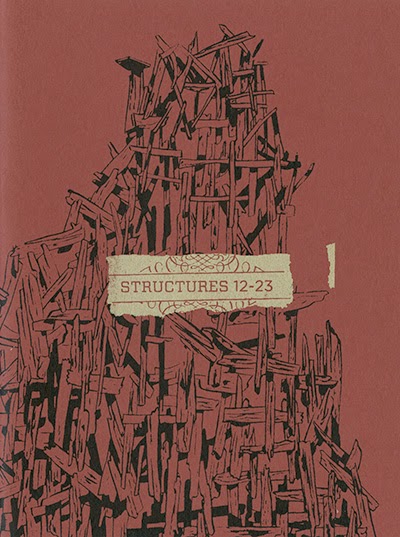
Structures 12-23 by Vincent Stall is the second mini-comic in "Uncivilized Books" series "Structures". In this series, various artists are contributing various structures or objects in a mini-comic format. I haven't yet seen all of the minis (Structures 1-11 by Tom Kaczynski and Structures 35-45 by Patrick Kyle), although I read Structures 24-34 this May. I will seek out the other issues shortly to get a better perspective on this project. Most likely at TCAF 2015. 

Vincent Stall's structures begins with a sort of civilizational collapse. A tabula rasa of some sort, unexplained and incomprehensible, that left the world in ruins. From those ruins, a new grotesque architecture rises to once again stomp on the environment and impose it's will on nature. It was fairly interesting to see this mini. What we see from the beginning is the destruction and collapse of a world order. We can't quite make sense of how it happened. The story and clues aren't straightforward, much like the buildings that make up the world. From there we navigate a world of ruins. Destroyed buildings, ruins and decay are everywhere. What is fascinating is that the residents of this wasteland have been cannibalizing the land and chopping trees to make their temporary habitats. This becomes a recurring motif in the book as each structure is less sustainable than the previous one. One is left to wonder how useful this environmental destruction can really be. If this is what we are doing with nature, creating freakishly deformed houses, perhaps it would be best to leave it alone. And perhaps, going further in this reflection, our own structures are distorted and our mutilation and constant exploitation of nature would look like this to an outsider. 

Decay
Temporary solutions
In 24 wordless pages, Stall forces the reader to reflect on current environmental issues and the very nature of our exploitative ways and environmental destruction. I almost feel bad for reading this on what is, in essence, a tree`s corpse. This is an important book and Uncivilized Books should be very proud to publish such a strong and thoughtful experiment. I have been through this book more often than I ever thought I would. It was a fantastic trip through decay and was really thought-provoking. Excellent.

Saturday, 24 January 2015

Jason's Lost Cat: A Lesser Work from a Superior Cartoonist

Loneliness in bright colors

I fondly remember the first book I read from Jason. It was in 2005 at the time when my interest in comics had started to fade. I went to the lesser of two comic book shops in Quebec City and was going to get yet another boring, tensionless, consequence-free, idiotic X-Men comic. I knew I had to read better stuff. I was a teenager back then and this was a time of personal growth for me. As much as I had enjoyed comics, I needed to see something, anything, better than the piles of crap pushed by the big companies. And I started browsing the small independent section of that store (one shelf) for anything of value, anything of importance. I found Hey, Wait..., by Norwegian cartoonist Jason. A 64-page graphic novel about loss, adulthood, loss of innocence and comics. It was minimalist and incredibly bold. It was what kickstarted my love of the medium. I began obsessing over the book, talking about it to everyone I knew. First the story struck me, then the structure of the story, then the layout, the use of space, the line work. It had a huge impact on me. I strongly believe that if you enjoy something, you can never be content with just having it, you have a burning desire to know all about it's inner workings; how it was made; by whom; and why and when; and how it relates to everything else you know. Hey, Wait... was the key to the comic book world I needed. It opened the door to better books and a greater appreciation of the art form. Years later, I still buy every book from Jason that comes out. It is a deeply personal experience for me, a sort of "going back to your roots" moment with every new page.

This is why I chose Lost Cat as the first Jason book I should talk about. Because Lost Cat, is a surprisingly disappointing read. Not content to simply have it on my shelf, I must channel this burning desire to look at it from multiple angles until I can decode it. Let's take a look at why this book in particular is such a letdown.


In Lost Cat, we follow Private Eye Dan Delon. As he finishes a very quiet day at work and heads home, he comes across a poster for a missing cat. As it turns out, the cat is nearby and he decides to return it to his owner. The owner, a woman around his age, answers the door and invites him in for a coffee. They sit and talk and this reveals their mutual sadness and desperation. In this moment, these two lost souls seem to find one another. They agree to meet again, leaving detective Delon enthusistically optimistic. Unfortunately, she never shows to their date, and worse yet, she has disappeared. Our detective investigates, and the woman remains very much in his thoughts. She becomes an echo; a vision of who he wishes she was. In his loneliness, he clings to to this woman, desperately so, as a way out of his misery. But loneliness follows him, and he cannot escape it. When our detective meets her again, it turns out she has a mysterious past and ulterior motives for being in the city. This revelation shatters his world. In the end, he'd rather fall into oblivion alone rather then face the flawed woman in front of him.

Jason developped a recognizable art style and it is in full force in this book. The characters are anthropomorphic animals. Dialog is sparse and used for dramatic or comedic effect. His style is minimalist, focusing on architecture, and small moments for the characters rather than the actions of the scenes. It works really well in this book as our detective is struggling with his loneliness. There are these long segments in which our protagonist stares at the void. He is alone in his apartment, he brushes his teeth, he sits and looks out the window. There aren`t many emotions or movement. It is slow moving and represents the dullness of everyday life and reflects on his state of mind really accurately. In most of his other books, the dialog is always used for a purpose, but in the case of Lost Cat, certain passages, mostly involving Detective Delon's parallel investigation, feel either redundant or unnecessary. This is one of the weaknesses of the book.


Why is this a lesser work? Because of it's inconsistency in storytelling. It feels as though the cartoonist had three separate ideas and tried to combine them all in Lost Cat. They feel disconnected. How about a detective who finds a lost cat? How about a H.G. Wells style Invasion of the planet by aliens? How about a detective on an investigation that goes sour? Th3se three main plots drive the book, but they don't mesh together well enough. The individual components taken on their own might work well, but they don't combine organically enough in the book. What we get in the end is a story about loneliness and trying to connect, desperately to anyone, or anything, no matter how deceitful. In this case, the woman turns out to be an alien and the vanguard for a global invasion. This big reveal doesn't feel earned, it just happens. I guess she is an alien? Thematically it fits, the woman disappeared and his world was destroyed, both mentally and physically. He always felt alienated and even though he has a chance to leave with her, she isn't who he wanted her to be. She's a lie and he cannot accept it. He'd rather be destroyed than be lied to. It should work, but it doesn't because this isn't a book about aliens, or destruction or lies. It's a book about loneliness and how difficult it is to find someone to be with. The two instances of foreshadowing feel tacked on as a last minute way to conclude the book. It robs the reader of the dramatic climax the book desperately needed.

Is it a bad book? No. Not by any stretch of the imagination. I think misguided may be more appropriate. Most of Jason's books have always integrated fantastical elements in their plots. It always seems to drive the story of our protagonist forward. Those elements are mostly integrated in the plot from the beginning. Frankenstein monster, time travel, pirates, zombie invasion, those are all included in the premise of the story and the characters transcend the basic premise of the genre. In The living and the Dead, a young man falls in love with a woman, but his efforts to court her are thwarted by the zombie apocalypse. When they are finally united, it feels earned, like the book was working towards it's goal the whole time. In Lost Cat, the sci-fi element feels like an afterthought. Almost like it was either forgotten on the first draft, or that it wasn't fitting properly in the story and was stapled on after the first draft. When we reach the end of the book, the pay off feels unearned. Thematically, it works, but narratively, it doesn't (if that makes any sense).

Yellow and Black

I rarely talk about the books themselves, the physical object. I will try to do so moving forward as, in some cases, it is important. Fantagraphics has done a tremendous job with this book. The hardcover format has a fantastic bright yellow cloth spine with bold black letters announcing the title. The primary colours on the front and back are black, white and some orange to add texture and depth to some images. The white font contrasts nicely with the black cover. The design of the cover is also great. It shows the detective opening the door and looking straight at the woman, but she is on the back cover. They are so close, yet worlds (or spines) apart. It also emphashizes the theme of loneliness as he cannot reach her. They are separated by an otherworldy yellow spine. It's a really nice looking book. Fantagraphics has been publishing them in this style for many years and it's absolutely gorgeous.
I wouldn't recommend the book to those who haven't read any other work by Jason. I Killed Adolf Hitler, Werewolf of Montpellier, You can't get here from there, and particularly, Hey, Wait... are all titles you should seek out first. If you've read some of his work before, you can find much to appreciate in Lost Cat, but remember that it may leave a sour taste. Jason is a true master of graphic storytelling, but this book is not his finest piece.

Finally, if you're interested at all, check out Jason's Blog Cats without Dogs. He posted as few process pieces around the time the book came out. Script and thumbnails, so go and take a look. Additionally, he has addressed some of the criticism he received from the book and answers some questions about Lost Cat

Monday, 12 January 2015

Superman is Typoglycemic


My wife gave me this Superman mug for morning coffee. It's the perfect intersection between comics and coffee. I didn't make much of it until someone pointed out that it was ludicrously misspelled. 

Good so far
Nothing wrong here...
Wait...What?
VILLIANS?
It's nice to know that it's not just DC Comics editorial team who sleeps on the job, their merchandising department does too. One massive typo on a mug contain 5 words. Good job!

Sunday, 4 January 2015

Strangebeard: An interview with Kelly Tindall


Kelly Tindall is an illustrator, cartoonist and teacher in Montreal. I first met him at the Ottawa ComicCon. He was doing a panel with Richard Starkings on Elephantmen and lettering, which was quite interesting. I’ve been following his work ever since. I’ve come to know Tindall a little bit over the years, by seeing him at shows and interacting online with him. I enjoy his work and style enough that he was amongst the first artists I thought of to create save the date cards for my wedding.  

He has worked for a number of years on Strangebeard, a webcomic about Jenny Brigham, a young girl who becomes a pirate after donning the hat of a pirate master. She absorbs a part of his soul and is possessed by his ghost. He successfully kickstarted a campaign to help print his webcomic and translate it in French.  He was kind enough to take some time for an interview post-kickstarter, post-book launch tour to talk with me. I have edited a few things for flow. 

Kelly Tindall's Blog

--


Philippe Leblanc: Tell me about your kickstarter experience. What kind of feedback did you get and how did it line up with your expectations going in?

Kelly Tindall: From the people who supported me in this Kickstarter effort, I'm slowly receiving feedback. I've sent the final copies and people are starting to receive them. Its been really gratifying to see people post pictures on social media. People seemed really impressed with the quality of the printing. The cover has a gold foil logo which turned out nicely. I think based on the feedback I got, people were generally happy and impressed by the final look of it. It looks like a trade paperback you'd get from a big comics company. The few minor issues with shipping and .PDF files have been ironed out as well. Overall, feedback has been very positive.


PL: I believe this was your first Kickstarter campaign. How did you feel about this platform going in?


KT: Yes, first campaign. I'm not an early adopter by any stretch of the imagination. I'm the guy that waits for all the updates to be applied before I download a game. The guy that waits for all the kinks to be removed from the iPhone before getting one. I knew some friends had done kickstarters, but at first Kickstarter felt almost like busking. I had done that early in my life and it felt penny anty and small. Over the years, I came to see that you can achieve a high quality level of production through Kickstarter. So I reconsidered and thought that through my experience at Image comics, I felt I had the knowledge to do a book, printing, distributing and all on my own. What I didn't know how to do, I could easily ask my friends and industry contacts, some people who were making comics since before I was even alive. So I parsed through these ideas and felt it was something that I could do. I could make my book, which was always the main goal. And since there were no publishers willing to take a chance on an all-age book starring a girl, I realized I was better off doing it myself. 


The feedback on that alone has been great. People come up to me and thank me for doing a book starring a girl, something they can share with their kids. It was always a no-brainer for me for this story. I wanted to juxtapose the big-bad, magic wielding pirates with someone more innocent and normal, and how better to do that than have a little girl. I don't know, it seems to be working, like I struck a chord with people that was always so obvious to me.


PL: It's interesting you shopped around your book to publishers, but there wasn't enough interest. Why is that you think?


KT: Well, I mean, there's a lot of factors involved with making a book. There's me, how I wanted the book to be for starters. I'm not a known quantity. I have a lot of credit to myself, but mostly it's for lettering, or colouring or fill-in issues. Nothing I can point to specifically to say "Look! I made this book". So that's a strike against "me", it's harder to get a foot in the door without being able to show something concrete. Then there is the story itself, an all-age book, starring a girl, and pirates. It's difficult to market. Publishers like to be able to tap into the young adult, older teenager market, this is too young for them. And as a comic book, how can you market that to the regular "30-40 male" demographic who buys comics, or is seen as it's biggest market. It's a new series, not established anywhere before, not a spin-off of anything so it's a wild card. You never know with kids what they'll float towards. Kids` whims are ever fickle and that's fine. We can't make the market bend to us. That's fine too. 


A few publishers liked the concept, the ideas and style, but weren't willing to take a chance on it. An even smaller number said they could publish, but were certain it wouldn't do the material justice. So I decided that it was better for me to do it on my own. 


PL: And this way, you get to have the book the way you want it.


KT: Exactly, and this way I have final say in everything. You shouldn't trust any artist who is 100% satisfied. I am mostly pleased with how it turned out. I'd change dozens of things, but you know what, all the mistakes are mine, start to finish. I'm not blaming anyone if the colours look weird somewhere or there's a continuity error here. That's all on me. I learned and will do better next time. It's a challenge to set up a campaign, run it and manage your funds once you have them. It was a challenge, but it was worthwhile for the book, but also for me as an artist and a person. It's good to be reminded that challenges exist, it means you're on the right track.


PL: Would you go through a similar exercise again, for a sequel or anything else?

KT: Yes. My tentative plan is to make 6 Strangebeard books. I may do a Kickstarter when I'm ready. I'm working on the second chunk of it (part 6 to 10). My next master plan is to publish The Adventurers which is my other webcomic. It's a diary strip about my daughter and family. It would be a mix of strip and longer narratives. I'd like a small hardcover, we'll see if there is interest from publishers on that end first, but I liked the campaign the first time around, so I might tap into that instead. I've had several requests for this. People like Strangebeard, but they love The Adventurers. It's a lot more personal and resonates with families more. Having a few copies of those handy would please many people, it would be a good mover at shows. 


PL: How long have you been working on Strangebeard?


KT: Officially, it will be 2 years in March, but the ideas and characters originated about two years prior to starting actual work on Strangebeard. I originally conceived it as a 3 to 4 panel webcomic, kind of like a newspaper strip, but that wasn't going to go anywhere and certainly not achieve what I wanted to achieve. I then transformed it into a more regular full page story online with the intention of publishing it at some point down the line. In it's current form, we're close to 2 years now.


PL: What was your initial motivations in creating this? What were you trying to accomplish with Strangebeard, both narratively and career-wise?


KT: Well, narratively, I didn't deviate much from what I had originally envisionned.  I went back and added more things for foreshadowing, but that's about it. I'm not sure I have all the kinks worked out with characterizations yet. I think I'm doing ok, but I'm not sure I'm applying this technique, or that literary technique, I'm doing it more intuitively. Maybe it's a good thing and it's working, 


Career-wise, it allows me to do more comic work both for myself, and for audiences. It allows me to point out to Strangebeard as the thing I created. I can showcase my style. It gave me some exposure too with companies, which led me to do some work this year for Monkeybrain and Blind Ferret, so it's happening. People are also hiring me to do work in my own style, and not force me to make my work look like someone else`s or a "house style" like DC or Marvel would have me do. It makes my work a lot more interesting, fun to do and I can work faster too. 


PL: It's better for morale and quality of life for sure. You mentioned earlier that you always envisioned Strangebeard as a printed book. When you started this webcomic, were you working for the screen, or for the page?

KT: Ultimately, it fits on screen, and reads well on tablet too. But I didn't care much, I wanted to do a comic that looked like a regular page of a typical comic you'd find everywhere. The fact it fits well on tablet and screen is an added bonus. I'm not pushing the limits of the medium. By no means am I someone like Boulet, constantly experimenting with the format. I wanted to create a page and have a way for people to see it.


PL: When you kickstarted your book, you threw yourself at the mercy of your fans and the internet, they may not have been as responsive as you hoped. How would you have seen Strangebeard continuing if it hadn’t worked?


KT: I'm not sure, maybe I'd have run another campaign on a different platform. I was quite confident I would make it. I've seen successful campaigns with smaller fanbases than the one I had. The only thing I didn't anticipate was how quickly it would work. I even managed to reach a couple of stretch goals. I knew it wasn't going to be a runaway success like Sullivan's Sluggers, but I knew I would at least make the minimum funding. I wasn't seriously worried about making it. I realized I had a following and that we could make this work and make everyone involved happy.


PL: I met you at Ottawa Comic-Con a few years ago and you were running a panel with Richard Starkings. Do you do regular panels in cons?


KT: Funny enough, Richard did help me out with this and he's a really great fellow. I just sent him his book last week and he immediately posted pictures to his social media pages of him reading it in the sunshine of Santa Monica.


I have to do more panels. I don't do as much as I should. They take away from your time at the table, but they're worth it. They bring in a different crowd than the people who walk up to you at your table. You're not selling them anything but you're providing knowledge on a bunch of things, these are always fun.


It's easier to reach people during those as well. Comicbook people aren't always charismatic and some have a hard time to strike up a conversation one on one if you're at your table. It's intimidating. So it helps to ease people into opening up once there is a common ground, or topic. I think it helps that I'm a teacher too so I have experience with groups like those.


PL: So you teach when you are not making comics?


KT: I teach night classes at the Montreal Syn Studio. It's an art school on St-Catharine where I teach introductory classes on comics. I get paid to think analytically about comics, and to teach people how to make comics and what makes them unique from a storytelling perspective. I get to flex mental muscle I may not be able to otherwise. It gets me out of the house and studio and it's good to be able to share knowledge on the art form. 


PL: Getting back to Strangebeard, I’ve noticed when reading the print version that some of the earlier pages felt a bit disconnected, like you were parsing through ideas as you went. How much of it was plotted when you started and how did that change over time? At what point did you know where you were going?


KT: I didn't script the book, I did plot it though. I can't write a script, it just doesn't feel right for the medium. I need to see it. When I start a chapter of Strangebeard, I sit down with a page and 22 or 24 thumbnails and I lay out everything I want to happen from the beginning until the point where the chapter ends. A lot of the time, I'll know where I want to end up, so I write as I go along so it looks more organic, sometimes, I'm not quite sure what they'll say, so I wait until I finish a page to add text to make it punchier. It has to work visually before it can work with text. It's kind of a disjointed and inelegant way to work, and it's sloppy, but it's what's working for me now. I know what I want to happen and when, but I need to leave myself some wiggle room too. If I script it, it's too rigid. I want characters to evolve organically, not because I force them to. I'm worried my characterization is suffering because of it. I want to make sure the characters feels right, distinctive and unique and memorable. I don't want people to remember characters just by what they're wearing or what type of weapons they use. I have to do what's right for me to make this work.


PL: As I said, at first, it feels more disjointed, but as you go through the book, this aspect seems to be less and less present. It seems like you've learned how to work with this technique efficiently, or at least you made it efficient. 


KT: Yeah, I agree. A big part of it was learning how to use this technique to give more breathing room for the characters. I knew where I wanted to go with the story, but I didn't want to just have "things" happening to the characters, I wanted them to feel fully formed. I was getting feedback from readers that Jenny was a fun character to read, particularly because of the juxtaposition of her mega attitude and her vulnerability. That was what people were responding to. They didn't want to read about a sort of Clint Eastwood type character, but they wanted to read about a little insecure girl trying to be this Clint Eastwood type character. 


So I started devoting more time to that and that's when I think it started flowing more freely. It helped once I realized that the core of the story was Jenny, Lemmy and Sealock as a sort of Tintin-Snowy-Haddock kind of group. This was perhaps clear for the reader, but not for me at first. I had originally envisioned that Sealock would die, he does goes to the plank in the opening and for the longest time, it was going to happen. Once I realized that Sealock had to live, it opened up more narrative opportunities. I'm a big believer in redemption. If you are willing to do the effort, you need to receive consideration for it. So part of the story eventually becomes the story of his redemption. And a clean redemption, not in a pirate, backstabbing, puppet master way, but as a person, a mentor and a friend. This, and how this will fit with the other pieces of the narrative, is really interesting to me. Jenny became the way to do it as I wanted her to save him. And it clicked: she will be bringing along people to their better selves whether they want to or not. It helped me figure out who she is. I want Jenny to have the attitude of the 12 year old, without the jerkiness of it. There's this part where Captain Morder is being all terrifying and evil and Jenny is just sassing her without being too much of a jerk teenager. 


PL: Since you mention the character of Jenny, Strangebeard is the story of this teenage girl learning how to become an adult. As a parent yourself, how do you feel your experience as a father influenced your writing of this character?

KT: I'm not sure how much of this has seeped into my writing yet. I might look at this in 10 years and tell myself "I had no idea what I was talking about". My oldest daugther will turn 4 soon. I get a lot from her, the willpower, the excitement over everything, but I don't get a lot of Jenny from her. There's not a whole lot I use from her now. Jenny is more of an amalgamation of all the strong women I met in my life and how I feel they would behave or react in those situations. She's not anyone really, she's many persons and resides in a compartment in my head. I feel like I know who she is now, better than when I started and it's a good thing and it works. At least I think it works, that's not up to me to decide.

PL: I had anticipated that Jenny would be a character inspired by your daugther, or at least some kind of role model you wanted for her. Your answer is quite interesting.

KT: Yeah, she's not a moral character for sure. One thing that always bothers me about pirate stories in general is that pirates don't do any pirating. Actual piracy is crime, bloodshed and mayhem. I wanted a bit of that in the story, she wants to rebel and be a criminal. I wanted some elements of it in the book, but without the blood and violence. It's really family friendly. She attacks a small fishing boat, she steals a precious heirloom from the governor's house, she's testing out the water to rebel and to see if piracy, being scary and evil is for her. She's in a morally grey zone, and one that all pirate stories must touch. Being an actual pirate is not fun, real life pirates are straight up bad guys. They're not all puns and swash buckling rogues, they attack ships and kill people. Modern pirates are too. I'm thinking of the most recent pirate movie that come to mind and that's Captain Philips. Pirates are criminals. The typical fictional stories involving pirates normally has the "good pirates" like Jack Sparrow and "bad pirates" like Blackbeard. I'm kind of doing this with the pirate masters in Strangebeard, but at this point, they're not so much interested in piracy so much as they are in revenge. 

PL: Since we're on the topic of piracy, how much of Strangebeard is inspired by the "Golden Age of Piracy", Caribbean pirate stories?

KT: Most of it, it's a very interesting period. It took place mostly in one part of the world and it was over in a few years. 

PL: Being established in Montreal yourself, do you feel you can get any inspiration from the province of Quebec naval history? Montreal and Quebec City were both trading cities established along the St Lawrence river and were tied to ships and naval history for centuries.

KT: It would be interesting to use it to get away from the violent connotations of this Golden Age piece. I don't know how much I can use. I researched some Canadian naval history when I started Strangebeard. Stories of privateering were interesting, but I'm not sure it gave me a lot of inspiration for my story. I couldn't get extra juice from it for the story I wanted to tell. My pirates aren't really analog to any real pirates. I don't have a Blackbeard, Black Sam or Henry Morgan or anything. There are references, but not any explicit ones. Even the pirate masters is more a reference to more contemporary media and not actual history. I'm taking bits and pieces. In a pirate story, you want to do the stuff, the naval battles, the treasure maps, the buried trasures, sword fights and adventures. But you also have to make it work with the context of the story. With Strangebeard, I want to hit story beats while mixing and integrating the tropes of the genre as well. I'm working on a buried treasure chapter, but I want to integrate structural elements from the heist movies and novels from the 60's moreso than the traditional "treasure island" thing. I want the story to move and integrate the elements of the sea without the deep focus on the naval history. I don't want my characters to be stuck at sea, with a "William Hope Hodgson survivalist style" story for a long period of time. It's more pop fun adventure. 

PL: So a more kinetic moving story inspired by these historical elements and genre tropes.

KT: Yes, a story that's propulsive. I don't want the story to be bogged down in the reality of it. I think it's important to get inspiration from many places and various media. There are elements of classic literatures, I'll integrate some kind of Sargasso Sea story. There are also elements of movies, comic books, kids cartoons even, like Johnny Quest and Duck Tails. It's integrating your influences and putting it back on the page. You have to see all of those stories, told differently across different platforms and see how it works, why it works and what resonates with you. You need to analyze it and understand it to pass on this energy onto your own work. You know its working when people are enjoying themselves. It transfers onto the work, much like a cook transfers his passion into his meals.

PL: Strangebeard is a family-friendly book in a lot of ways. I can see kids and parents alike reading the book. What type of feedback have you received on the book from parents, and how does that differ from feedback from kids?

KT: I've received feedback from parents concerning how their kid enjoyed it. Some have told me they ran and read it cover to cover and asked for more. Girls between 8 and 14 seem to really enjoy it. I haven't gotten much in the way of official reviews, but I've received positive feedback from those who bought the book either for themselves or for their kids, which was mostly the case. Kids seem to really enjoy it. It's got a different base than I anticipated, a bit older than I thought, but people are reading it and are excited about it and as a creator, I couldn't ask for more. 

I'm really excited for the future of this. I have so many ideas and concepts and things to explore. Grey zones and breaking down cliches and what not.


For more information on Kelly Tindall's work, check out the links below.

Kelly Tindall's Blog
Kelly Tindall's Tumblr
Kelly Tindall's Portfolio

All images from Strangebeard can be found at http://www.strangebeard.com/

Thursday, 4 December 2014

Samuel Cantin's Vile & Miserable: Sadness & Comedy

Vile, Miserable, Shallow and Funny

With the ongoing Pow Pow Press Kickstarter campaign to translate a portion of their catalog in English, I thought I should weigh in and write about one of the books they are aiming to translate. Samuel Cantin's Vile & Miserable is a bizarre comedy which follows the adventures of Lucien Vil, a sad and miserable bookstore employee. His store shares space with Linguine Used Automobile. The book chronicles Lucien's life in 4 days (October 31st, November 1st, January 6th & February 2nd). The premise is more than a little ridiculous; Lucien is a demon who sells used literature in a used car dealership. I'll leave it at that. The interesting aspect of the book is that when you sift through this ludicrous premise, you discover a very thoughtful portrait of sadness and how it can affect one`s life. 

Halloween is the most wonderful day of the year. Not Christmas. Christmas Sucks.

The comedic aspect of Vile & Miserable comes from the tone and situation in which the characters evolve. The characters' voices are distinct and very modern. Cantin has a good understanding of the way people talk and adapts it for the page very nicely. You can understand the character's education and social class based on the way they talk and what they talk about. For example, Lucien is more educated (or at least well-read) and is more sarcastic, frequently making numerous books and extra-textual references to their authors. His psychologist is also educated, but comes from a lower class area. He is crude, surprisingly so, swears often and talks in slang. I found this to be quite refreshing. The comedic elements aren't limited to language, but they are facilitated by it.

Let's just add this mustard on your sandwich

Vile & Miserable are two signifiers that seem to apply for all the characters in the book. The protagonist, Lucien Vil, is sad man. Abstinent for over 40 years, he carries with him his repressed sexual desires and hopelessness at fulfilling them. He lashes out against his colleagues and co-workers frequently. Sylvain Linguine, the owner, is a nicer man, but completely delusional towards his business prospect (The used car industry is dying and he thinks he should start making a living out of the book industry instead?) His new assistant is a nice enough kid, but he's ignorant and a little clueless. These characters all combine organically within the awkward situations they are projected into. This creates absurd situations where they all appear disfunctional, delusional, and miserable. No one goes unscathed in this book. 

You're a real groupie ass kisser spending all your time online checking out author`s shoe sizes. No one gives a crap. Who had syphilis or not. They all had syphillis, every single one of them. 
My only negative comment is the book`s portrayal of women. Unfortunately, none of the female characters (of which there are very few) are portrayed positively. The secretary of the dealership is referred to as an old hag. A woman on the bus is objectified with a ridiculous amount of vile mentions of her pussy. The psychologist secretary is a dumb underage bimbo. Granted, the male characters don't fare much better in terms of being portrayed positively, but their "problems" appear to be more complex than the women. The psychologist's secretary that appears in the third act of the book proved to be very problematic. She is a 16 year old girl who's in love with a man who seems to be 4 to 5 times her age, she's stupid and doesn't have a problem with being objectified in front of perfect stranger. This characterization just seemed too easy to me. The psychologist though is just as miserable a character. He was attracted to "her juvenile charm" when she was only 14 years old. Some might find it funny, but I felt it was lacking the smart spark of the first act and seemed to be just weirdly out of place.


Overall, this book was quite funny. Cantin manages to mix sadness and comedy very well. It didn't land completely with me, but I've read it twice and will gladly read other books by this artist. I encourage everyone to consider Pow Pow Press Kickstarter campaign. The other books on offer Mile End by Michel Hellman and For as long as it rains by Zviane are absolutely fantastic. It would be a very nice addition to anyone's collection and a breath of fresh air for the English comic book market. 


Saturday, 29 November 2014

Gerry Alanguilan & Arlanzandro C. Esmena's Where Bold Stars Go To Die: The Fading Light of Love and Memories

Fleeting Memories
One can always recall the people one had strong feelings for. I remember the first time I really liked a girl. She was in my class when I was 7. She was cool, and she liked the same things I liked: Batman and biking. But as time passed, I forgot more and more. Such is the nature of memories. They are fleeting and untraceable. I can't remember her name anymore, just that she was a tattoo artist`s daughter. But these memories, these feelings, they affect us. Where Bold Stars Go To Die, much like Sam Alden's "Hawaii 1997" is about being attached to the memories of someone we liked, loved even. Some of us will spend our life looking for this love, while most of us will move on. But the memories, as fleeting as they are, will remain, forever trapped in amber, until they disappear within our subconscious, internalized and accepted as a part of us. 


Where Bold Stars Go To Die is a touching story about love and the memories of love. It traces the story of Daniel, a young man and his passion and love towards a Philippino porn actress. He becomes obsessed with this "Bold Star" and this obsession intertwines desire, lust and dreams. In this book, the Bold Stars remain alive in an idyllic dream environment, sustained by the desire of those who once admired them. The Star he liked, however, is remembered by no one else and her light will soon be extinguished. As much as I objected to the fact that women can only seem to survive if they are sexualized, the story goes beyond that aspect fairly quickly. It doesn't mean it's not problematic from a gendered perspective, but it's not only about this. It's a book about obsession, intimacy and loneliness. It is also a mature, thoughtful and honest reflection on sexuality. In fact, one could argue that despite their status as exploited actresses, they hold the power over the men, who are driven to the point of insanity by their obsessive lust for them. One can read the story in many ways. It is about the nature of memories, lust and dreams after all, I don't think there's one correct answer on the matter.


It is very interesting as it talks about a cultural aspect I never ever considered before; Bold Star, and softcore pornography in the Philippines from the 60's to the early nineties and it's influence on comics. Interestingly, there was a whole style of comics "Bomba Komiks" that became really popular during that time. I'll let you read the article I linked to if you feel like getting more information on the matter. What is interesting is that this became a cultural artifact of sorts, one that many use as a source of inspiration.


The real draw here is the art and the letter Gerry Alanguilan wrote on the artist Arlanzando C Esmena. It is unfortunately the only book by Esmena, as he passed away from cancer in (INSERT DATE). The mastery on the page is nothing short of impressive. Esmena is able to depict the nature of a fantasy in a very interesting way, particularly in the first few pages. The way he used breaks and angles to show how fantasies are not linear is quite clever. The panel distribution also reinforces this aspect. The panels are broken up, showing almost no fluid movement, but fragments of specific moments in Daniel's fantasy narrative. The "Eden" of the stars is truly remarkable. We feel the depth in the forest and the landscape. He is quite skilled at executing shadows. He uses proper lighting and shadows with different angles throughout the book. He is also very adept at drawing the human form, and in particular the human face. 

I read the book multiple times, very carefully each time to appreciate the craftmanship of each panel. I'd recommend it for the art alone, but Alanguilan's thoughtful essay at the end of the new edition on Philippino comics and his friend and colleague Arlanzandro is truly touching. The pin-up gallery alone is worth a look. A lot of contributors to this gallery will be familiar to those who read american superhero comics: Leinil Francis Yu and Philip Tan in particular have provided some amazing contributions. It's an interesting and heartfelt book and will remain a testament to the fading memories of those who we once loved, and those who disappeared too soon.

Sunday, 23 November 2014

Dash Shaw's Doctors: Social Accountability and Depression

Out of control
What does it mean to be a doctor? And as a society, what do we expect from our physicians and specialists? A doctor is someone who practices medicine, helps to cure and treat the ailments, injuries or pains of his patients. As a society, we want them to be competent, pluripotential and for them to be able to respond to the healthcare needs of the community. If they are specialists (ranging from surgeons, pediatricians, neurologists or anything else), we expect them to be efficient, knowledgeable and excel in their functions. The last century has seen major changes and increasing demands on healthcare systems. We live longer and our health care needs have changed. We face challenges to improve quality of care; to be equitable and effective; and to provide care in various locations and conditions across the country without reducing the quality of care. This means that our doctors are required to deal with increasingly challenging environments than they were before. We need our doctors to be socially accountable. We need our doctors to provide quality health care to a diverse and under-served population. They need to be able to meet the numerous needs of various patients in this increasingly medically complex world. 

Dash Shaw's Doctors was a very interesting read for me. Improving medical education is what I do for a living so this tied my career and my hobby together quite nicely. One of the main struggles of the book is to balance the requirement to meet society's needs and being socially accountable while remaining loyal to your immediate environment. 


A team of Doctors operates clandestinely using a machine called the "Charon". It allows it's user to invade the brain of a dying patient minutes before dying as they are creating the afterlife they want, or feel they deserve in their final moment. While in the brain, they try to bring the person back to life, away from the light at the end of the tunnel, if you wish. We follow Dr. Tammy Cho (daughter of the inventor of the Charon) as she attempts and eventually succeeds at bringing a woman named Bell back to life  But bringing someone back doesn't mean that they are cured and all survivors suffer from severe depression after being reanimated. And how could you not? In a way, after seeing what is waiting for you on the other side, be it love or despair, you would know it to be eternal. Wouldn`t that be incredibly depressing no matter the outcome­? We read of Dr. Cho's struggles to reconcile her father's control over the machine and its use for profit as they embark on a dangerous operation. We also follow's Ms. Bell's attempt to recapture what she saw in the afterlife and her failure to live up to her final dream. 

The opposite of social accountability
One of the main struggles for Tammy is to find, not only meaning in what she does, but also how to make sure it benefits society. She is well aware of the potential benefit of the Charon and that it should be used more widely. She asks her father: "Why aren't we a charity?" Why aren't we helping out society? Why are we unaffordable? The search for profit might not be the only thing that matters she seems to say. She genuinely wants to help and provide better treatment to her patients. She knows of the severe depression her patients suffer after being revived (p.45). She knows that it should be part of their duties to help their patients deal with the trauma. What is the point of reviving someone if you know that, without a doubt, they won't be able to handle their return?

Her father, Dr. Cho also has a ludicrous number of misconducts that relates to his career. For him, being a doctor is a success in and of itself, and to be successful, you need money. He cannot consider that in a situation of need, he would be expected to help someone for free. He even let in to his friend that he wouldn't save him for free. When his friend Clark jokingly says "With you around, I don't have to worry about dying." Cho simply answers "Don't push your luck". He also measures his success in terms of how many patients he brought back from life, not their survival rate, which is abysmally low. When Miss Bell breaks his car window, he mumbles that "She broke the car she paid for. She's gonna die soon anyway". Reading this, I felt that he must have known that his conduct was severe malpractice. He operates clandestinely, without supervision of any kind and he constantly worries someone will tell on him. When his daughter asked him why they weren't a charity, he answered that "it wouldn't work. The Catholics would shut us down." I think he meant any sort of health care regulatory body would shut him down.


Trauma is also another recurring element of this book. For Tammy and her father, their trauma stems from the loss of the mother. She died during a robbery that went wrong. The killer was found and killed, but the wound never healed. She was the emotional core of the family and once gone, her family lost their happiness. Now the pain has hardened Dr. Cho, and only the pursuit of his work can soothe the pain. In a lot of ways, his personal life stopped when he lost her. For Miss Bell, the damage that came with her revival is unbearable. In her afterlife, she fell in love with the pool boy, a young man who loved her despite her age and fortune. He simply loved her for who she really was. The shock of coming back to life and losing that happiness is intolerable. The depression that sets in afterward is overwhelming and insurmountable. Those traumas define the characters and only the tragic circumstances at the end of the book will allow them to move on.


Depression is not only the plight of the survivor, it is also the plight of the living. Both Tammy and Will struggle with everyday life. The toll of working on the edge of the afterlife is particularly impactful for them. Tammy is constantly wondering whether she`s alive or not and checks regularly for sensations (like heat) that she wouldn't feel in the Charon. A constant reminder that she is still alive. She also struggles to reconcile the dichotomy of her work. She wonders whether she is ending up like her patient Ms  Bell, "Drifting through life, waiting to die" only to end up with delusional thoughts of self-importance to justify living through another without sinking deeper, "I'm like a magician Our work is going to be famous and studied for centuries". She's unable to make meaningful connections and spends her nights lost in the game "The Sims", where her avatar is a surgeon so she "can really be helping other sims". Will is not much better. He reflects on the Egyptians' view of the afterlife, struggles to find love and thinks dark thoughts about the inevitability of death and the collapse of civilization. "Eventually your consciousness sputters out. You dissipate. You fade to Black. Just like how eventually our whole world, every culture, will explode and we'll all just be fucking cosmic dust. We'll all dissipate. We'll all be nothing and everything. What's more spiritual than that?"


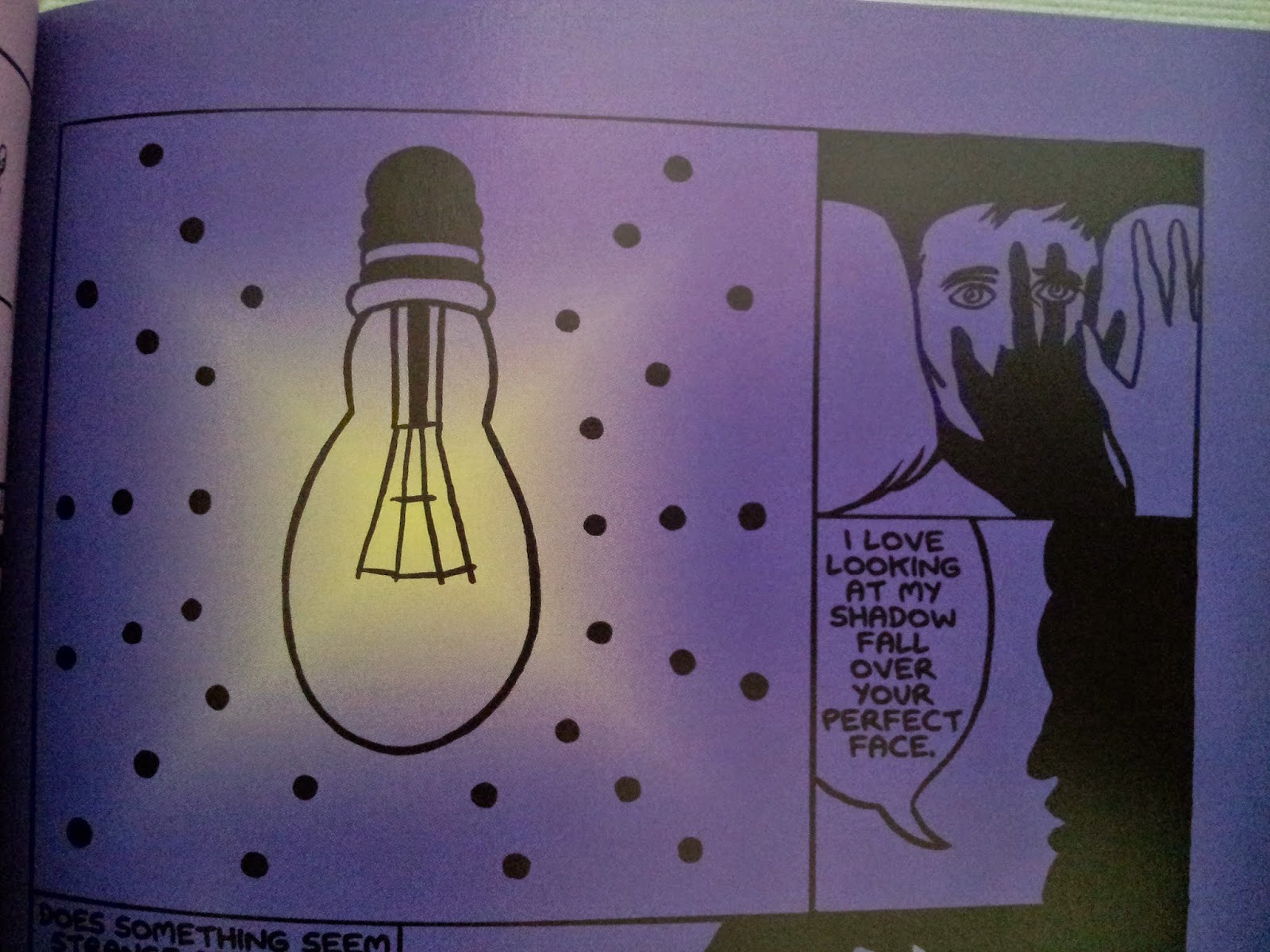
Dash Shaw also makes good use of color. Each page is of a single color and this adds depth to both the drawings and the tone of the story being told. This is also helped with the way that the story is told: all through vignettes of 1 to 2 pages. The color helps convey information on feelings and the tone for each page., The effect works much better here than in his previous work "New Jobs", The goal was the same in both books, but the effect was different due to the length and size of the page. "New jobs" was a single panel per page, and a small page at that. In Doctors, the story is displayed on multiple panels and it allows for the feelings to be conveyed more effectively. The color permeates the narrative of the page, creating feelings of melancholia, nostalgia, dread or light-hearted moments.


Dash Shaw created a remarkable book that is relevant to modern issues in medicine. It addresses mortality, spirituality and depression in a colorful package. I'd highly recommend this to anyone regardless of your interest in health care.