|
| As of writing this, same-sex-mariage has been legalized in the US |
A constantly beating drum in the comic book industry is the call for more diversity. It's an important issue, both socially and financially. Since different creators bring in new ideas and fresh new stories informed by their individual experiences. Since the conception of the "superhero" comic book, North America has grown increasingly multicultural. There are so many exciting discussions on aboriginal rights, LGBTQ issues, and other topics; it's phenomenal to see it unfolding. Diversity means introducing new creators that bring with them a new point of view, new ideas and stories and their own authorial stamp. It's also important for the mainstream publishers to move toward diversity as well from a financial point of view. The customer base is much broader than the stereotypical young adult white male (although that age category is debatable, and a late 30 to early 50 age range is probably more accurate nowadays). Superhero movies are multi-million dollar blockbuster. People are interested in this topic and when they look to buy comics, if they only see an insular world of white creators and characters, chances are they won't come back. Alienating potential customers in a modern world where you can access any form of entertainment easily and you`re being constantly bombarded by new opportunities for leisure is not financially viable. Diversity of characters, creators and point of view is the way of the future, it may be the only way comics not only survive, but strive.
The Ottawa Comic-Book Book Club met this month with Marjorie Liu to discuss the first collection of her run on Astonishing X-Men. Our group have different interests in comics: some tend to appreciate structure, design, plot, characters, art or even color. Our regular comic reading habits rarely coincide. Although most of us were familiar with X-Men, few of us understood the minutia underlying their world. Marjorie gracefully accepted to join us for a discussion on X-Men, diversity, marriage, her career, collaborating with other creators and working for Marvel.
 |
| What the Book Club was wondering prior to our discussion |
Marjorie Liu started the discussion with explaining how she ended up writing for a comic book in the first place. She had originally studied to become a lawyer and even passed the bar, but after she finished school she didn`t feel that practicing law was the right path for her. She wanted to write and so she turned her mind to that. She wrote her first novel, Tiger Eye, a paranormal romance book (and the first of her Dirk Steele series) in about a month in 2005. She became an author, wrote more books and eventually wrote an X-Men novel for Marvel called X-Men: Dark Mirror. Her comic career began in earnest with NYX: No Way Home, then Dark Wolverine, X-23 and Black Widow until she was approached for Astonishing X-Men.
Since Astonishing X-Men was well established by that point, she had to use the characters already on the team for her stories. This included Wolverine, Gambit, Iceman, Northstar, Warbird, Karma and Cecilia Reyes. She took a look at the characters and decided that one of the first plot-lines she would work on would be to move the character of Northstar forward. Northstar came out of the closet in the mid 90's in Alpha Flight #104, and had been in a relationship with his partner, Kyle Jinadu, since 2009. Marvel Comics approached this idea enthusiastically and cautiously as they wanted to ensure it would be done properly. Many editorial suggestions and re-writes later, the story was accepted. Although well publicized, she didn't anticipate a good reception to the comic. The issue was anticipated and Marvel did warn her that she would likely receive "minor death threats". There was no backlash and the issue was received favorably. It was not an action packed issue, but a thoughtful, heartfelt and intimate look at the characters involved and the reactions of those around them. Overall, the story of the wedding was well done and well received.

The group really enjoyed the character moments found in this collection. How the characters interacted with each other was a highlight of the book. When Kyle Jinadu and Northstar are unpacking, Kyle requests Northstar uses his speed power to furnish the apartment quickly. When they come back from the fight, Northstar is flying and carrying Kyle in his arms. This makes Kyle feel inadequate as he was caught in the crossfire of a vicious battle earlier and couldn't contribute to it. Those little moments are aplenty for each character in the book and they were very welcome. It was quite refreshing to see so much effort being put into developing these characters and making them feel fleshed out.
We quickly understood that for Marjorie, comic stands at the intersection between prose and screenplay. The process she normally uses for writing books is quite different than for her comics. She has to think about her characters, who they are, what they're saying, what they're thinking and how to express those elements in words. In comics, those same train of elements aren't necessarily conveyed by words, but by a combination of dialog, narration boxes and visuals. The challenge lies in finding the right way to collaborate with an artist to illustrate what you hope to see. Through good communication and collaboration, artists bring their vision of how they see a scene and the team ends up with something that satisfies them both. The strengths of all creators elevating the work of the other. This is a really good way to work with someone.
The inclusion of New York imagery within the books was also a welcome addition. We knew the X-Men were based in New York (or San Francisco now), the town where the action took place rarely seemed to matter. Marjorie and Mike Perkins create a City that feels real. The X-Men are taking a cab after a fight, they're eating a slice of pizza in Greenwich Village pizzeria, a wedding in Central Park. This is New York and it feels lived in. We understand where they are instead of thinking they're in generic location #23.

The group really enjoyed the character moments found in this collection. How the characters interacted with each other was a highlight of the book. When Kyle Jinadu and Northstar are unpacking, Kyle requests Northstar uses his speed power to furnish the apartment quickly. When they come back from the fight, Northstar is flying and carrying Kyle in his arms. This makes Kyle feel inadequate as he was caught in the crossfire of a vicious battle earlier and couldn't contribute to it. Those little moments are aplenty for each character in the book and they were very welcome. It was quite refreshing to see so much effort being put into developing these characters and making them feel fleshed out.
We quickly understood that for Marjorie, comic stands at the intersection between prose and screenplay. The process she normally uses for writing books is quite different than for her comics. She has to think about her characters, who they are, what they're saying, what they're thinking and how to express those elements in words. In comics, those same train of elements aren't necessarily conveyed by words, but by a combination of dialog, narration boxes and visuals. The challenge lies in finding the right way to collaborate with an artist to illustrate what you hope to see. Through good communication and collaboration, artists bring their vision of how they see a scene and the team ends up with something that satisfies them both. The strengths of all creators elevating the work of the other. This is a really good way to work with someone.
The inclusion of New York imagery within the books was also a welcome addition. We knew the X-Men were based in New York (or San Francisco now), the town where the action took place rarely seemed to matter. Marjorie and Mike Perkins create a City that feels real. The X-Men are taking a cab after a fight, they're eating a slice of pizza in Greenwich Village pizzeria, a wedding in Central Park. This is New York and it feels lived in. We understand where they are instead of thinking they're in generic location #23.
 |
| Cabbing home after a fight |
This collection however, was downright confusing and jarring for us to read. Since it begins with issue #48 of a well-established series, it assumes you have a good understanding of who is involved and the background information of the characters. Most of us could recognize Wolverine and Gambit, but we all scratched our head when Warbird is introduced. Particularly since she appears to have killed one of her enemies so those of us who didn't know she was an X-Man assumed immediately she was an enemy. It's not so much an issue of poor storytelling, so much as it's an issue concerning the insular nature of the X-Men in general. You need a PhD in X-Men and a Wikipedia page open before being able to understand the stories being told. As for the jarring feelings, well the collection only tells half a story. Obviously the focus is on Northstar, but the central plot concerns a villain using mind control to get at the X-Men. Why I couldn't tell because the story abruptly ends at what I assumed is a halfway mark. The collection does conclude (or appear to conclude) Northstar character`s arc, but leaves you right in the middle of the main story arc. After the wedding, a cliffhanger happens, then it's a short story from an unrelated comic published 4 years earlier. Then it's the story of Northstar coming out of the closet which features this stupid guy:
How these issues are collected is not a decision by the creative team, but rather their editorial team. Though we may be cynical, it wasn't hard to understand that this was collected as soon as possible to cash in on the publicity of the wedding issue regardless of whether or not it was narratively coherent. From a business perspective, it make sense, you want to make sure you squeeze out sales while the trend is still fresh because you`ll lose out on those sales the longer you wait. Removed from that context, years after the publication, it's just jarring and kind of obscene. As readers, how can you take this seriously? We all understand that the serialized nature of comic books means that "the story is never really over", but how much can you stretch that elastic before it bursts? We as readers felt the story to be important, but can the same be said of the editorial team? Does this encourage readers at large to pursue the other collected editions? I'm not sure. We're a large group of individuals and our tastes vary. I'm not sure that paying a premium fee for half a story that ends with a guy in a penguin suit, a top hat and a monocle telling you "well if you like this, you gotta buy the next book to see how it ends, huh huh!" is the right way to ensure longevity with sales. No one likes to be taken for a fool. This probably explains why sales of comic books (at least floppies) have been steadily declining. There's only so much insults one can take.
Again, this wasn't something Marjorie or her colleagues had any control over so we couldn't really fault her for it. This did bring us to the topic of creator-owned comics and of the extra liberty this brings about. Marjorie is currently working on a creator owned project for Image Comics called Monstress with Sana Takeda. Monstress takes place in a fantasy 1900's Asia, where mythic beasts roam the land and we'll follow a young girl with a psychic connection to one of those beasts as she is hunted by many who wish to exploit that connection. The release date was still up in the air at the time of our meeting but we were assured it would be "soon, very soon". We could tell Marjorie was eager to talk in depth about this project. The amount of freedom that this allowed her was quite exciting. How long will the series be? How many pages will the first issue have? How will it be collected? Will there be guest artists and who could they possibly be? All of these things will be determined by her, Sana and their colleagues.
And this extra liberty is just something you can't have at a corporate comic publisher. The corporation owns the right to the work, the universe and the characters. At the end of the day, nothing you do belongs to you. And this is a subject we've encountered before in discussion with other comic artists and writers we spoke to. They may be invested in the work they've done, and once they leave, they may want to come back to it later, but there is no guarantee they'll ever be involved in it again. It can be quite frustrating and this seems to be what is pushing a lot of established creators toward owning their own material. It won't always be successful, but it will belong to them and that control, that ownership, is worth a lot more than you can imagine.
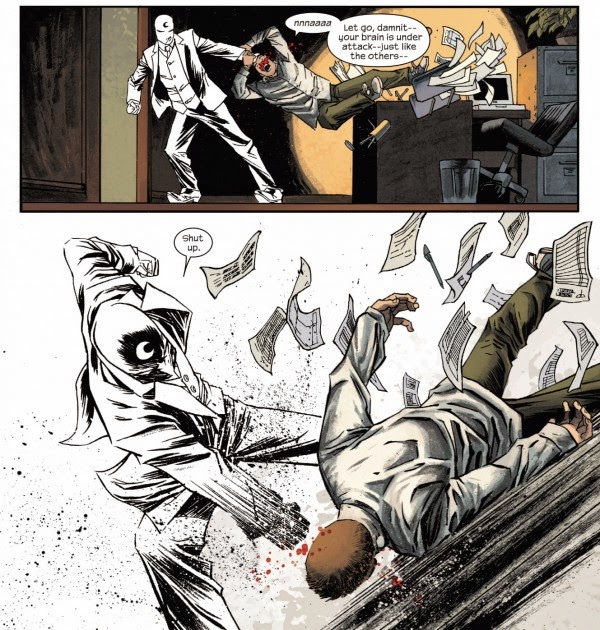
On the subject of collaboration, Marjorie mentioned that, although it's always a good thing to know your collaborator's strengths, it's also important to understand your own weaknesses. Being humble and recognizing where your weaknesses lies allowed her to collaborate with colleagues much better. For example, Marjorie mentioned that she will often rely on the artist she works with to create fight sequences. This allows the artists to make better choices concerning the page layout and the action that unfolds. The two of them know where the action is going and what needs to happen, but the fluidity of movement and how exactly the same takes place doesn't rely only the writing of Marjorie, but on a collaborative process where the artists and writer contribute to construct the scene. The results in this comic, for example, is seamless. The action flows nicely from one panel to the next without skipping a beat. Knowing what your collaborators are good at is great, knowing where they can help you can sometimes be even better.
On the subject of diversity, Marjorie talked to us about her own experience at Marvel. She's always felt welcome and supported by her colleagues. While she recognized that she has worked with a diverse team, mostly at the editorial level, that didn't extend to the level of writer and artists` teams that were around her. The call for diversity has been beating louder and louder across the internet and hopefully publishers are listening (N.B. Although it's hard to tell if they're listening or if they're completely tone-deaf. Only 8 women will be working on the 45 title Marvel relaunch of October 2015). There will never be a time when we'll be able to say we have "enough" diversity. As I mentioned earlier, those new creators bring with them new ideas and stories, it's just hard to ignore the positive outcome both from a story perspective and from a PR perspective. Most members of our book club are women and the idea that comics are a "boys club" is difficult to shake. Marjorie was kind enough to let us know she feels things are moving in the right direction, albeit at much slower pace than anyone wants to admit to.

We were able to have a solid discussion with Marjorie and gain a better understanding of her experience as a writer by the end of our meeting. We learned much about collaborative process, diversity and the process behind the comic book in terms of editorial input. Leaving the meeting, we all had mixed feelings about the book, myself included. Not all of us were sure that we would recommend the book. It was a flawed experience, mostly due to how the book was collected. A cautionary tale perhaps for overeager editors. In any case, we were quite thankful for the time Marjorie took to speak with us. Her eloquence, candor and honesty was quite riveting. We're looking forward to Monstress and her upcoming projects. Some of us have already started reading her novels. Truly the mark of a captivating author.
 |
| The least stereotypical Canadian character ever created |
How these issues are collected is not a decision by the creative team, but rather their editorial team. Though we may be cynical, it wasn't hard to understand that this was collected as soon as possible to cash in on the publicity of the wedding issue regardless of whether or not it was narratively coherent. From a business perspective, it make sense, you want to make sure you squeeze out sales while the trend is still fresh because you`ll lose out on those sales the longer you wait. Removed from that context, years after the publication, it's just jarring and kind of obscene. As readers, how can you take this seriously? We all understand that the serialized nature of comic books means that "the story is never really over", but how much can you stretch that elastic before it bursts? We as readers felt the story to be important, but can the same be said of the editorial team? Does this encourage readers at large to pursue the other collected editions? I'm not sure. We're a large group of individuals and our tastes vary. I'm not sure that paying a premium fee for half a story that ends with a guy in a penguin suit, a top hat and a monocle telling you "well if you like this, you gotta buy the next book to see how it ends, huh huh!" is the right way to ensure longevity with sales. No one likes to be taken for a fool. This probably explains why sales of comic books (at least floppies) have been steadily declining. There's only so much insults one can take.
Again, this wasn't something Marjorie or her colleagues had any control over so we couldn't really fault her for it. This did bring us to the topic of creator-owned comics and of the extra liberty this brings about. Marjorie is currently working on a creator owned project for Image Comics called Monstress with Sana Takeda. Monstress takes place in a fantasy 1900's Asia, where mythic beasts roam the land and we'll follow a young girl with a psychic connection to one of those beasts as she is hunted by many who wish to exploit that connection. The release date was still up in the air at the time of our meeting but we were assured it would be "soon, very soon". We could tell Marjorie was eager to talk in depth about this project. The amount of freedom that this allowed her was quite exciting. How long will the series be? How many pages will the first issue have? How will it be collected? Will there be guest artists and who could they possibly be? All of these things will be determined by her, Sana and their colleagues.
And this extra liberty is just something you can't have at a corporate comic publisher. The corporation owns the right to the work, the universe and the characters. At the end of the day, nothing you do belongs to you. And this is a subject we've encountered before in discussion with other comic artists and writers we spoke to. They may be invested in the work they've done, and once they leave, they may want to come back to it later, but there is no guarantee they'll ever be involved in it again. It can be quite frustrating and this seems to be what is pushing a lot of established creators toward owning their own material. It won't always be successful, but it will belong to them and that control, that ownership, is worth a lot more than you can imagine.
 |
| A lived in city for the X-Men |
On the subject of collaboration, Marjorie mentioned that, although it's always a good thing to know your collaborator's strengths, it's also important to understand your own weaknesses. Being humble and recognizing where your weaknesses lies allowed her to collaborate with colleagues much better. For example, Marjorie mentioned that she will often rely on the artist she works with to create fight sequences. This allows the artists to make better choices concerning the page layout and the action that unfolds. The two of them know where the action is going and what needs to happen, but the fluidity of movement and how exactly the same takes place doesn't rely only the writing of Marjorie, but on a collaborative process where the artists and writer contribute to construct the scene. The results in this comic, for example, is seamless. The action flows nicely from one panel to the next without skipping a beat. Knowing what your collaborators are good at is great, knowing where they can help you can sometimes be even better.
 |
| Nightmarish dream vision |
On the subject of diversity, Marjorie talked to us about her own experience at Marvel. She's always felt welcome and supported by her colleagues. While she recognized that she has worked with a diverse team, mostly at the editorial level, that didn't extend to the level of writer and artists` teams that were around her. The call for diversity has been beating louder and louder across the internet and hopefully publishers are listening (N.B. Although it's hard to tell if they're listening or if they're completely tone-deaf. Only 8 women will be working on the 45 title Marvel relaunch of October 2015). There will never be a time when we'll be able to say we have "enough" diversity. As I mentioned earlier, those new creators bring with them new ideas and stories, it's just hard to ignore the positive outcome both from a story perspective and from a PR perspective. Most members of our book club are women and the idea that comics are a "boys club" is difficult to shake. Marjorie was kind enough to let us know she feels things are moving in the right direction, albeit at much slower pace than anyone wants to admit to.

We were able to have a solid discussion with Marjorie and gain a better understanding of her experience as a writer by the end of our meeting. We learned much about collaborative process, diversity and the process behind the comic book in terms of editorial input. Leaving the meeting, we all had mixed feelings about the book, myself included. Not all of us were sure that we would recommend the book. It was a flawed experience, mostly due to how the book was collected. A cautionary tale perhaps for overeager editors. In any case, we were quite thankful for the time Marjorie took to speak with us. Her eloquence, candor and honesty was quite riveting. We're looking forward to Monstress and her upcoming projects. Some of us have already started reading her novels. Truly the mark of a captivating author.
 |
| Looking forward to this |